Attend the 23rd Annual Meander Art Crawl!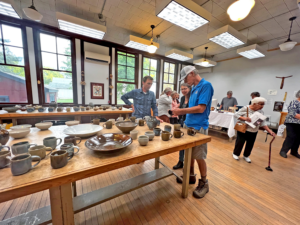
The 23rd annual Meander Art Crawl will take place on October 2, 3 & 4! Meander through the beautiful fall colors of the Upper Minnesota River Valley visiting 28 studios featuring 40 local artists. Browse and shop one-of-a-kind pieces of pottery, jewelry, paintings, photography, woodwork, mixed media, and so much more!
The UMVRDC continues to provide technical and financial management for the Meander since its inception and is pleased to see continued growth and support for the event.
Meander Website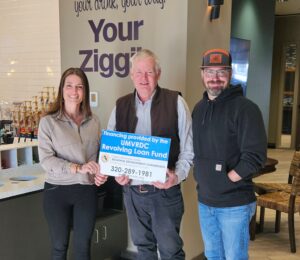 UMVRDC RLF
Are you planning to start, expand, or strengthen your business in western Minnesota? The UMVRDC Revolving Loan Fund (RLF) is here to help make that growth possible.
The RLF provides gap financing to support new and existing businesses across Big Stone, Chippewa, Lac qui Parle, Swift, and Yellow Medicine counties and we currently have over $4million in loans with 42 businesses in the region and we have significant resources still available. Our goal is to help local entrepreneurs access capital that complements bank loans and other funding sources—so projects that benefit our region’s economy can move forward.
What the RLF can help finance:
- Real estate purchases
- Equipment purchases
- Working capital
Why businesses choose the UMVRDC RLF:
- Competitive interest rates
- Flexible terms
- Support for projects that might not qualify for traditional financing alone
- Local staff committed to strengthening our region’s economic vitality
If you’re exploring a new business idea or looking to expand, we encourage you to reach out. Our team can walk you through the process, answer questions, and help determine if the RLF is a good fit for your project.
Learn MoreUMVRDC Property Assessed Clean Energy Program
Unlock cost‑effective clean energy improvements for your business or property with the UMVRDC Property Assessed Clean Energy (PACE) Program.
PACE makes it easier than ever to invest in energy‑efficient and renewable upgrades for your business or farm. Through this innovative financing tool, businesses owners can complete projects that reduce energy costs and improve buildings— all financed through a property tax assessment with no upfront costs.
Eligible Projects Include:
- HVAC upgrades and high-efficiency heating/cooling systems
- Insulation and building envelope improvements
- Solar energy installations
- Geothermal systems
- Lighting upgrades
- Other approved renewable or efficiency enhancements
Why Choose PACE Financing?
- No upfront capital required
- Long-term, fixed-rate financing
- Savings from energy efficiency can offset project costs
- Financing stays with the property, not the owner
- Supports local contractors
- You may be eligible fo rebates from your utility provider or tax incentives that further reduce the cost of the project
Power your project, lower your bills, and invest in your business’s future.
Learn MoreLocal Road Improvement Program Can Help with Funding Transportation Priorities
Through the UMVRDC annual survey of the region, providing information about funding resources is an important service the UMVRDC can offer. Increase Road/Bridge Funding was #2 as a most important topic in 2025, and has been in the top 10 for many years. Below is a resource for road funding for local units of government that may be useful.
The MnDOT Local Road Improvement Program (LRIP) provides funding assistance to local agencies and Federally Recognized Indian Tribes for construction, reconstruction, or reconditioning projects.
Applicants must be state aid eligible. Cities that are not a State Aid city (populations less than 5,000) and townships must have a county project sponsor and support of the County Board. A city or township resolution in support of the project and a county board resolution for support and willingness to sponsor the project must be included in the application package.
Projects are eligible in three areas:
- Trunk Highway: The project must be located on a local road owned by the local entity that is impacted by a Trunk Highway project.
- Regionally Significant. Demonstrate the regional significance of the route by being classified as a major collector or higher unless it meets one of the following criteria; a) identified in a regional plan as a farm-market artery, b) part of a 10-ton route system, c) part of an economic development plan, d) serves as a regional tourist destination, e) provides capacity or congestion relief to a parallel trunk highway or county road, and f) is a connection to the regional system, trunk highway, or a county road.
- Rural Road Safety Account: The project must be located on a rural County State Aid Highway.
LRIP funding does not require any local match, and grants are paid on a reimbursable basis.
Learn More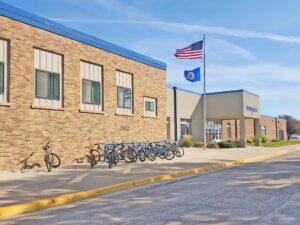 Upcoming Transportation Infrastructure Funding Opportunities and Webinars
Several major state and federal transportation funding opportunities are coming this fall, creating opportunities for communities to invest in sidewalks, ADA accessibility improvements, trails, bicycle and pedestrian infrastructure, Safe Routes to School projects, and electric vehicle charging infrastructure.
Successful applications are rarely developed in the final weeks before submission, so now is the time to prepare! Communities that begin planning early are often better positioned to submit stronger applications and secure funding.
Transportation grants frequently require project scoping, cost estimates, local match commitments, maintenance agreements, resolutions of support, and coordination among multiple partners. Communities considering future funding should begin identifying priority projects, evaluating local match capacity, discussing long-term ownership and maintenance responsibilities, engaging partners, and determining whether projects align with adopted plans.
The following opportunities may be a good fit for local communities.
Transportation Alternatives Program
Supports sidewalks, shared-use trails, pedestrian crossings, bicycle facilities, and ADA improvements. Typically funds 80% of project costs with a 20% local match. Letters of Intent are generally due in October, with applications due in winter.
- Funds are available for projects constructed in 2031
- 20% local match is required
The Transportation Alternatives Solicitation is a competitive grant opportunity for local communities to fund projects for pedestrian and bicycle facilities, Safe Routes to School and more. Minnesota will be soliciting projects for approximately $12.5 million in available grant funding across the state where the total is sub-targeted to the seven area transportation partnerships (ATPs).
Active Transportation Program – MnDOT
Supports walking, biking, rolling, trail connections, and pedestrian safety projects. Infrastructure grants generally provide up to 100% funding, and planning assistance is available for communities preparing future projects.
- Funds are available for projects constructed in 2027 or 2028
- There is no funding match required.
The Active Transportation (AT) Program provides grants and technical assistance to make walking, biking and rolling better. Our program aims to increase the number of people walking and biking to destinations.
Infrastructure Grants – Safe Routes to School – MnDOT
Supports sidewalks, crossings, ADA improvements, trail connections, and other school-area safety projects. Infrastructure funding may provide up to 100% of eligible costs, and planning assistance is also available.
- Funds are available for projects constructed in 2027 or 2028
- There is no funding match required.
These funds are available statewide to communities to construct infrastructure that improves access and safety on prioritized routes to and at schools. A Safe Routes to School plan is recommended to apply (but not required). Any type of plan that highlights the community’s need through engagement will support applications. This could be an Active Transportation Plan, a Bike/Ped Plan, Trails Masterplan, Long Range Transportation Plan, or through a transportation section within a Comprehensive Plan.
The Planning Grants that are for the creation of or updating of Safe routes to School Plans will also be available in October – more information to come soon!
Communities do not need to have fully developed projects before reaching out. Early planning often leads to stronger applications and better positions communities to take advantage of future funding opportunities. Contact us to talk through your idea! The UMVRDC is available to work with communities to identify funding opportunities, develop project concepts, coordinate stakeholders, and prepare competitive grant applications.
UMVRDC to Host Lunch and Learn
On Wednesday, October 7 at noon, UMVRDC will be hosting an informational webinar for employers about the Minnesota Secure Choice Retirement Program.
What is this?
Established in 2023, Minnesota Secure Choice is a state-facilitated, employer-supported retirement program that gives employees a reliable, accessible tool to build their own savings. It allows employers with 5 or more employees to provide a competitive retirement savings benefit at a low cost with minimal administrative burden.
Minnesota Secure Choice’s mission is rooted in accessibility and empowerment. Through automatic payroll deductions into an individual retirement account (IRA), Minnesota Secure Choice makes saving effortless. Workers keep full control of their accounts, benefit from low fees and maintain portability across jobs, while employers avoid the cost and complexities of managing their organization’s own retirement plan.
Minnesota Secure Choice Retirement Program
The Minnesota Secure Choice Retirement Program is expanding access to retirement savings for Minnesota workers who do not have access to a workplace retirement plan, while offering employers a simple and streamlined way to facilitate participation.
The presentation will explain employer eligibility, compliance requirements, onboarding processes, payroll integration options, and the support resources available to assist businesses. It will also highlight the program’s strong early growth and its role in improving long-term retirement security for workers across Minnesota.
Who is this for?
Private businesses and non-profit entities employing 5 or more employees
Register Here
2026 UMVRDC Annual Tour & Meeting Recap
This year, UMVRDC staff and commissioners gathered in Montevideo at the Veteran’s Home for our annual tour and meeting, spending the afternoon exploring local projects, businesses, and community initiatives happening throughout the city. The tour provided an opportunity to see firsthand how regional partnerships and programs are supporting economic development, housing, childcare, local businesses, and community services.
We started the day with a presentation from UMVRDC staff on the Small Cities Development Program (SCDP) and throughout the day heard about other UMVRDC-supported initiatives. We also learned about the Minnesota River Valley CEO program, regional childcare efforts through DEED grants, and the new CCM Health Childcare Center, which is expanding childcare capacity for local employees and families. This facility was also a stop on our tour.
The tour included local businesses supported through UMVRDC’s Revolving Loan Fund (RLF), including Ziggi’s Coffee, Madsen Chiropractic, and Round the Table. We also stopped at A to Z Letterpress, where we learned about the business’s history and connection to the Meander Art Crawl, as well as the renovation of the new location for Chippewa County Family Services.
The day wrapped up with a tour of the Veteran’s Home, dinner, and our annual business meeting. We’re grateful to the community leaders, business owners, organizations, and presenters who shared their stories and welcomed us throughout the day. Annual tours like this give us a chance to see the impact of local projects firsthand and strengthen the partnerships that help communities across our region continue to grow and thrive.


UMVRDC at Midwestern Legislative Conference
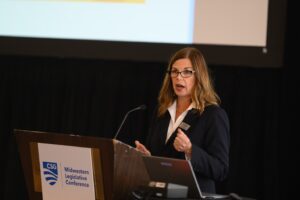
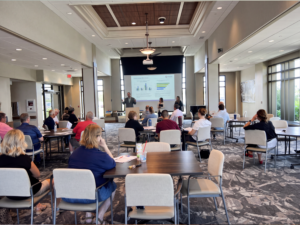
UMVRDC Executive Director, Dawn Hegland, recently spoke on a panel about rural economic development in Minnesota at the Midwestern Legislative Conference in St. Paul.
“The MLC is a nonpartisan association of all legislators representing 11 states (Illinois, Indiana, Iowa, Kansas, Michigan, Minnesota, Nebraska, North Dakota, Ohio, South Dakota and Wisconsin) and the Canadian province of Saskatchewan. The provinces of Alberta, Manitoba and Ontario are MLC affiliate members.
The purpose of the MLC is to foster cooperation among the region’s policymakers through the consideration of common problems, the exchange of information and ideas, the sharing of knowledge, and the pursuit of collaborative efforts to improve state government.”
Dawn focused on the work of regional development commissions and some unique aspects of the enabling legislation in Minnesota.